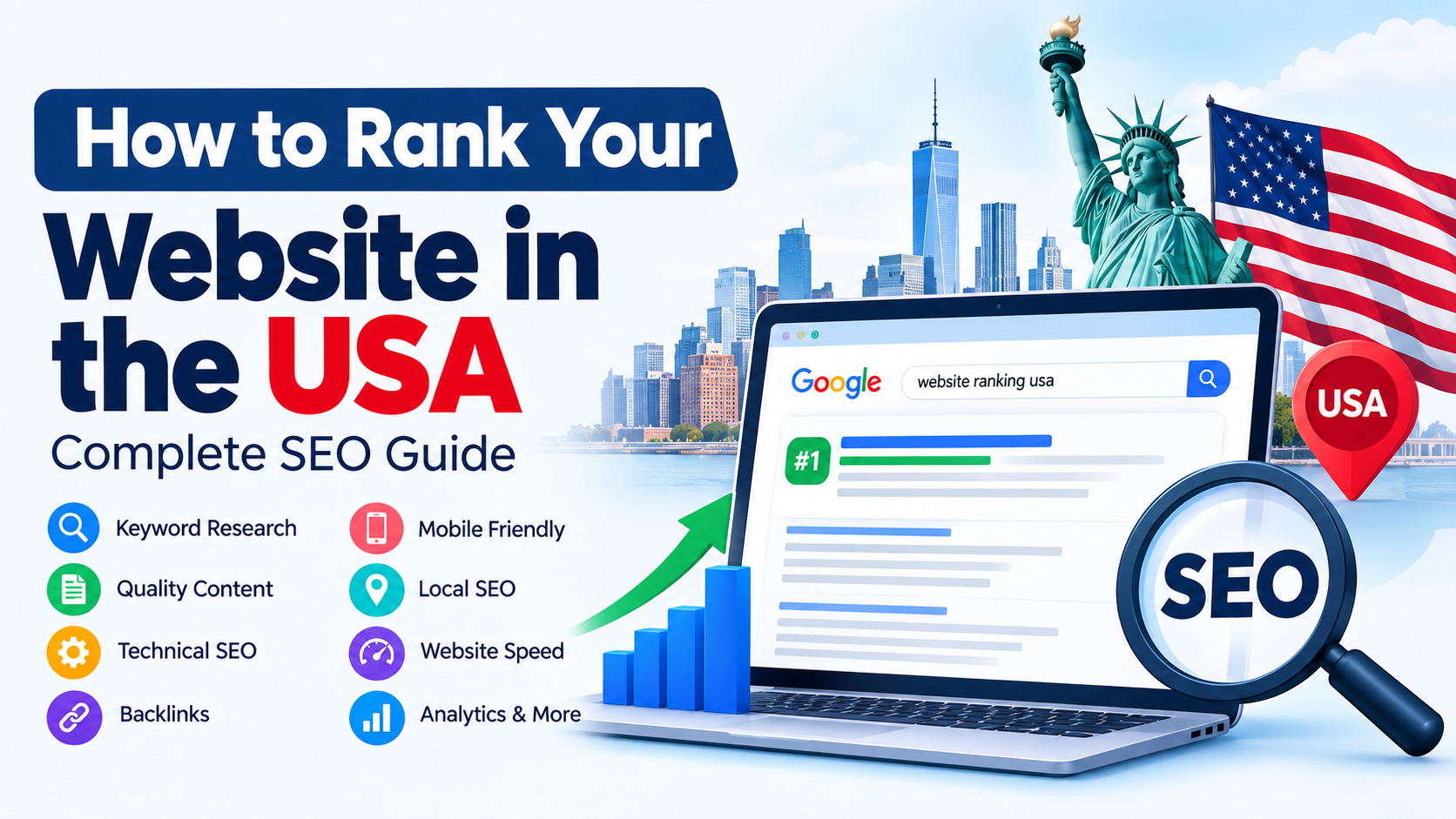
How to Rank Your Website in the USA: Complete SEO Guide
Ranking a website in the USA can help you reach millions of potential customers, generate organic traffic, build brand authority, and grow your online business. However, targeting the US market requires more than simply publishing content in English.
You need a proper USA SEO strategy that focuses on keyword research, high-quality content, technical SEO, backlinks, website performance, user experience, and search intent.
In this guide, we will explain how to rank your website in the USA step by step.
1. Understand Your USA Target Audience
Before starting SEO, identify exactly who you want to reach in the United States.
Ask yourself:
- Who are my potential customers?
- Which US states or cities am I targeting?
- What problems are they searching for?
- What products or services do they need?
- Are they searching from mobile or desktop?
- What keywords do they use?
For example, instead of targeting a broad keyword like:
"website development"
you could target:
"website development company in USA"
or a more specific search such as:
"Flutter app development company in New York"
Understanding search intent is one of the most important parts of successful SEO.
2. Perform USA Keyword Research
Keyword research is the foundation of your SEO strategy.
Use keyword research tools to find keywords that people in the USA actually search for.
Look for:
- High-volume keywords
- Low-competition keywords
- Long-tail keywords
- Commercial keywords
- Informational keywords
- Location-based keywords
- Question-based keywords
For example, if you sell SEO services, possible keywords could include:
- SEO services USA
- SEO company USA
- affordable SEO services USA
- SEO consultant USA
- local SEO services
- SEO agency in New York
- best SEO company for small business
Don't focus only on keywords with huge search volume. Lower-volume, highly relevant keywords can often generate better-quality traffic.
3. Create Content Specifically for the US Market
One of the biggest mistakes websites make is creating generic content and expecting it to rank everywhere.
If the USA is your target market, create content that is genuinely useful for US users.
For example, include:
- US examples
- US pricing where appropriate
- US regulations when relevant
- US locations
- US customer problems
- US-specific statistics
- US terminology
- US-focused case studies
Avoid simply adding the phrase "USA" repeatedly to an article. Google can understand context, and keyword stuffing can make your content worse.
4. Build Topic Authority
Instead of publishing random articles, build content around specific topics.
For example, if your website is about Flutter development, create a content cluster around Flutter:
Main Topic
Flutter App Development
Supporting Articles
- How to Start Flutter Development
- Flutter BLoC Tutorial
- Flutter Clean Architecture Tutorial
- Flutter Firebase Authentication
- Flutter REST API Integration
- Flutter App Performance Optimization
- How to Publish a Flutter App
- Flutter Interview Questions
Then internally link these articles together.
This helps search engines understand your website's expertise and makes it easier for users to discover related content.
5. Optimize Your On-Page SEO
Every important page should have properly optimized on-page SEO.
Focus on:
SEO Title
Create a clear title that describes the page and naturally includes your primary keyword.
Example:
SEO Services USA: Complete Guide for Businesses
Meta Description
Write a compelling description that explains what the user will learn or get from the page.
URL
Keep URLs short and descriptive.
Good:
example.com/seo-services-usa
Avoid unnecessarily complicated URLs containing numbers and unrelated parameters.
Headings
Use a logical structure:
- H1 for the main page title
- H2 for major sections
- H3 for subsections
Content
Use your target keyword naturally throughout the content. Include related terms and answer the questions users are actually asking.
6. Improve Website Speed
Website performance is important for both users and search engines.
A slow website can increase bounce rates and reduce conversions.
Improve performance by:
- Compressing images
- Using modern image formats such as WebP
- Minifying CSS and JavaScript
- Reducing unnecessary scripts
- Using browser caching
- Using a reliable hosting provider
- Implementing a CDN
- Removing unnecessary plugins
- Optimizing database queries
You should also pay attention to Google's Core Web Vitals.
7. Make Your Website Mobile-Friendly
A large amount of web traffic comes from mobile devices.
Your website should work properly on:
- Android phones
- iPhones
- Tablets
- Laptops
- Desktop computers
Check:
- Font size
- Button size
- Navigation
- Page speed
- Image scaling
- Forms
- Popups
- Mobile menus
A good mobile experience can improve both usability and conversions.
8. Build High-Quality Backlinks
Backlinks remain an important part of SEO.
A backlink occurs when another website links to your website.
However, don't focus on getting thousands of low-quality links.
Instead, try to earn links from relevant and trustworthy websites.
You can build backlinks through:
- Guest posting
- Digital PR
- Original research
- Helpful resources
- Industry directories
- Expert interviews
- Linkable guides
- Partnerships
- Case studies
- Data-driven content
For example, if you publish an original study about Flutter app development, other technology websites may reference your research and link back to it.
9. Create Link-Worthy Content
The easiest way to earn natural backlinks is to create something worth linking to.
Examples include:
- Original research
- Statistics
- Free tools
- Calculators
- Detailed tutorials
- Industry reports
- Templates
- Checklists
- Comprehensive guides
- Case studies
Instead of asking hundreds of websites for links, create resources that people naturally want to reference.
10. Target US Cities When Relevant
If your business serves specific locations in the USA, create location-specific landing pages.
For example:
- SEO Company in New York
- SEO Company in Los Angeles
- SEO Company in Chicago
- SEO Company in Houston
- SEO Company in Miami
But don't create hundreds of nearly identical pages just by replacing city names.
Each location page should provide unique and useful information about that market.
11. Optimize Your Google Business Profile
If you operate a local business in the USA, create and optimize a Google Business Profile.
Make sure your business information is accurate and consistent.
Add:
- Business name
- Address
- Phone number
- Website
- Business category
- Opening hours
- Photos
- Services
- Customer reviews
Encourage genuine customers to leave reviews.
Local SEO is especially important if you want customers from specific US cities or regions.
12. Use Internal Linking
Internal links connect pages on your own website.
For example, if you publish an article about:
"How to Optimize a Flutter App"
you could link to related articles about:
- Flutter performance
- Flutter architecture
- Flutter BLoC
- Flutter app publishing
Internal linking helps users discover more content and helps search engines understand the relationship between your pages.
13. Optimize Images
Images can also contribute to SEO.
Use descriptive filenames.
Instead of:
IMG12345.jpg
use:
flutter-app-development-guide.jpg
Also add useful alt text where appropriate.
For example:
Alt text: Flutter app development architecture diagram
Compress images before uploading them to reduce page size.
14. Create an SEO-Friendly Website Structure
Your website should be easy for both users and search engines to navigate.
A simple structure could look like:
Homepage
│
├── Services
│   ├── SEO Services
│   ├── Web Development
│   └── App Development
│
├── Blog
│   ├── SEO
│   ├── Flutter
│   └── Web Development
│
├── About
│
└── Contact
Keep important pages easy to reach.
15. Set Up Google Search Console
Google Search Console is one of the most useful free tools for SEO.
Use it to monitor:
- Search queries
- Impressions
- Clicks
- Average position
- Indexing
- Sitemap status
- Page experience
- Search performance
Submit your XML sitemap and regularly check for indexing problems.
16. Submit an XML Sitemap
An XML sitemap helps search engines discover your important URLs.
For many WordPress websites, SEO plugins can automatically generate and update the sitemap.
After creating your sitemap, submit it through Google Search Console.
17. Fix Technical SEO Problems
Technical SEO can have a major impact on your rankings.
Regularly check for:
- Broken links
- 404 pages
- Redirect problems
- Duplicate content
- Canonical issues
- Incorrect robots.txt rules
- Indexing problems
- Slow pages
- Mobile usability issues
- HTTPS problems
Use Google Search Console and a professional SEO crawler to identify technical problems.
18. Use HTTPS
Your website should use HTTPS.
For example:
https://example.com
instead of:
http://example.com
HTTPS helps protect information exchanged between users and your website and is an important baseline for a modern website.
19. Improve Your E-E-A-T Signals
Google wants users to find reliable information.
For websites where trust and expertise are especially important, clearly demonstrate:
- Experience
- Expertise
- Author information
- Business information
- Contact details
- Sources and references
- About page
- Editorial policies where appropriate
For example, technology tutorials can benefit from showing who wrote the article and demonstrating practical experience with the technology.
20. Keep Your Content Updated
SEO is not a one-time activity.
Old articles can lose rankings when competitors publish better and more current information.
Regularly update important pages.
Check:
- Outdated information
- Broken links
- Old screenshots
- Old statistics
- Missing sections
- New search intent
- New competitors
Instead of publishing hundreds of low-quality articles, focus on maintaining your most valuable content.
21. Analyze Your Competitors
Find websites that already rank for your target keywords.
Analyze:
- Their content
- Page structure
- Search intent
- Backlinks
- Internal links
- Topics they cover
- Featured snippets
- Page experience
Then ask:
"What can I provide that is better or more useful?"
Don't simply copy competitors. Improve upon what already exists.
22. Use Long-Tail Keywords
Long-tail keywords often have lower competition than broad keywords.
For example:
Broad keyword:
"SEO"
Long-tail keyword:
"how to rank a small business website in the USA"
Long-tail searches can attract users with very specific needs and often provide excellent opportunities for newer websites.
23. Focus on Search Intent
Always understand why someone is searching.
Search intent generally falls into categories such as:
Informational
"How does SEO work?"
Commercial Investigation
"Best SEO tools for small businesses"
Transactional
"Buy SEO software"
Navigational
"Google Search Console"
Your content should satisfy the intent behind the search rather than simply repeating keywords.
24. Promote Your Content
Publishing an article doesn't guarantee traffic.
Promote useful content through appropriate channels such as:
- Social media
- Industry communities
- Email newsletters
- Online publications
- Professional networks
- Relevant forums
The goal is to put your content in front of people who may genuinely find it useful.
25. Be Patient
SEO normally takes time.
A new website should not expect to rank for highly competitive US keywords immediately.
Your results can depend on:
- Website age
- Competition
- Content quality
- Backlink profile
- Technical SEO
- Search intent
- Industry
- Website authority
- Consistency
Think of SEO as a long-term investment rather than a quick traffic hack.
USA SEO Checklist
Before targeting the US market, make sure you have:
- ✅ USA keyword research
- ✅ Search-intent-focused content
- ✅ Optimized title and meta description
- ✅ SEO-friendly URLs
- ✅ Mobile-friendly design
- ✅ Fast website
- ✅ HTTPS
- ✅ Internal linking
- ✅ High-quality backlinks
- ✅ XML sitemap
- ✅ Google Search Console
- ✅ Technical SEO monitoring
- ✅ Original content
- ✅ Author and business information
- ✅ Local SEO where relevant
- ✅ Regular content updates
- ✅ Competitor research
- ✅ Analytics and conversion tracking
Final Thoughts
Ranking a website in the USA requires a combination of quality content, technical SEO, keyword research, authority building, user experience, and consistency.
Don't try to manipulate search engines with keyword stuffing, spammy backlinks, automatically generated low-value pages, or duplicate content. Instead, build a website that genuinely solves problems for your target US audience.
Start with a focused group of keywords, create the best content you can, optimize your website technically, build legitimate authority, and continuously improve based on real search data.
With a consistent SEO strategy, your website can gradually increase its visibility in Google and attract valuable traffic from users across the United States.